What your workspace can hold, and how much of it you're using
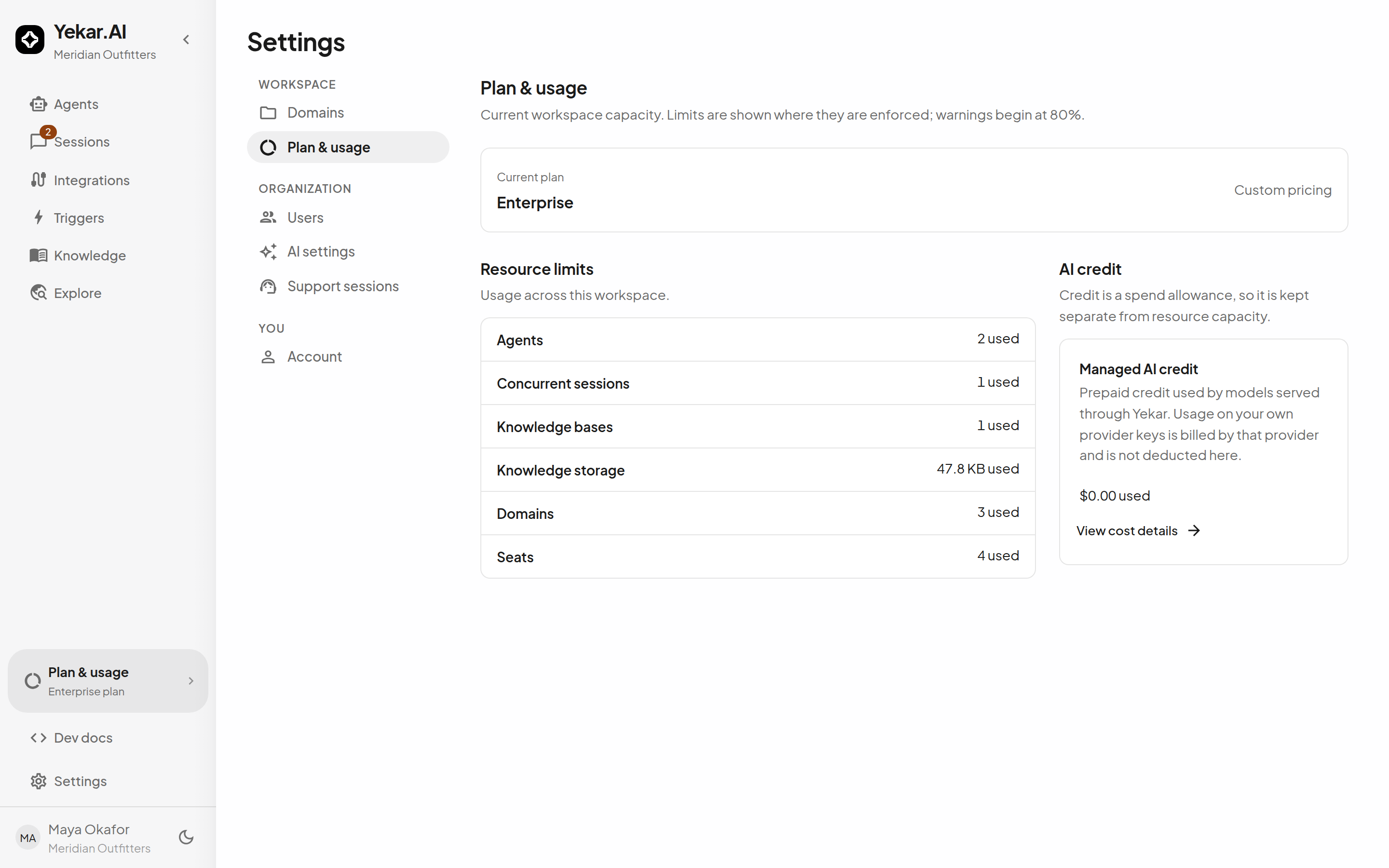
Plan & usage at the foot of the sidebar answers two questions that otherwise get answered by hitting a wall: how much capacity this workspace has, and how much of it is spoken for.
Starting a paid plan
When creating an organization from the pricing page, verify your email first, then complete payment on Get started. The organization remains unavailable until the payment provider confirms a successful charge. Sign in again to continue an unfinished signup. A payment that is still being confirmed shows a status check; check its status before paying again.
After activation, Plan options opens the existing plan and renewal controls. The available payment methods and currency follow your organization's billing country. Where offered, choose a one-time monthly purchase or automatic monthly renewal.
Your subscription
Under the plan's name the card says what happens next: Renews on 1 Oct, Trial ends in 9 days, or Ends 30 Sep - the workspace is suspended after that. A subscription runs in periods - a month at a time - and renews on its own until it is cancelled or its agreed term ends.
When a subscription ends, the workspace is suspended, not deleted: new runs and sessions are refused, everyone can still sign in, and every agent, flow, document and conversation is kept. The page then reads Ended 30 Sep - the workspace is suspended, and a new subscription lifts the suspension. Organization admins are emailed when a trial is three days from ending, when a subscription is seven days from ending, and when it has ended.
For a mid-period plan change, contact Yekar.AI. Automatic renewal can be cancelled from the renewal controls; access continues through the period already paid for. If the workspace was suspended by an operator instead, the subscription's clock is paused for as long as the suspension lasts, so a suspension never costs you time on your plan. If a plan change has been agreed for your next renewal, the line under the plan says so - Renews on 1 Oct · moves to Pro then - so nothing about your price or limits changes without the date being on the page first.
Resource limits
Every limit is a cap on growth, checked when you create something - never applied retroactively. Reaching one never stops work that already exists: your agents keep running, your sessions keep going, and the refusal is on the next create.
| Limit | What it counts |
|---|---|
| Agents | Agents in the workspace |
| Concurrent sessions | Sessions allowed to be busy at the same moment |
| Knowledge bases | Knowledge bases across all domains |
| Knowledge storage | Total bytes of knowledge content |
| Domains | Domains in the workspace |
| Seats | Members of the workspace |
Each row shows what you have used against what you may use, with a bar that turns amber at 80% and red once the limit is reached, and links to the list it counts so you can see what is taking up the room. (The Seats link opens the member list, so it is there for organization admins only.) A limit with no ceiling reads as a plain used-count - it is unlimited, not unknown.
Credit
Credit is a spend allowance, so it is kept apart from resource capacity. It covers models served through Yekar.AI - the managed option in AI providers. Work running on your own provider keys is billed to you by that provider and never deducted here, which is why a workspace on its own keys can show credit untouched while models run all day.
With a subscription the allowance is granted per period - the caption reads "used this period" and names the day the next allowance arrives - and whatever is unspent rolls over. At 80% of the period's allowance organization admins receive an email; at a zero balance, models served through Yekar.AI are refused until credit is added, while work on your own keys carries on.
Organization admins get View cost details for the full breakdown by month, domain, and agent - see Organization defaults and budgets.
Billing history and invoices
Organization admins get two more tabs. Billing history is the workspace's money and credit statement: plan payments, credit purchases, plan credit grants, daily usage and expiries. A plan payment shows the plan and the period it paid for, the amount in the currency you paid in, and a link to its invoice; usage rows link through to the cost breakdown for that day.
Invoices holds one document per payment - a plan purchase, a renewal, or a credit top-up - issued the moment the payment is captured, numbered in sequence, and never changed afterwards. Open one to print it or save it as a PDF from your browser. The Billing details card on that tab is who invoices are made out to: legal name, address, tax ID and billing email. Save it before you pay and it prints on every invoice from then on; an invoice issued before it was saved carries the workspace name and says so. Editing the details never rewrites an invoice already issued.
Tax. A workspace whose billing country is India pays 18% GST on top of every price - plan purchases, renewals and credit top-ups alike - and every price you see before paying shows the total with the GST line beneath it. Workspaces billed elsewhere pay the listed price. An invoice states the tax that was actually charged; where an older payment carried no tax breakdown, its tax line reads not itemised on this payment rather than a zero.
Tips
Two different things can stop a session from starting, and they read alike: Concurrent sessions here is the capacity your plan bought, while a workspace also has a platform fairness cap that makes new work wait rather than refusing it. If sessions are queuing rather than being refused, the plan limit is not what you are hitting. If a create action is refused outright, this page names which ceiling you reached.