Organization knowledge
An agent is only as good as what it knows about your business. Knowledge is where your policies, price lists, playbooks and product specs live - curated once by the people who own them, and bound to every agent that needs them.
Update the return policy in one place and every agent citing it is current on the next turn. Nobody re-uploads a file into six agents, and nobody has to wonder which copy was the recent one.
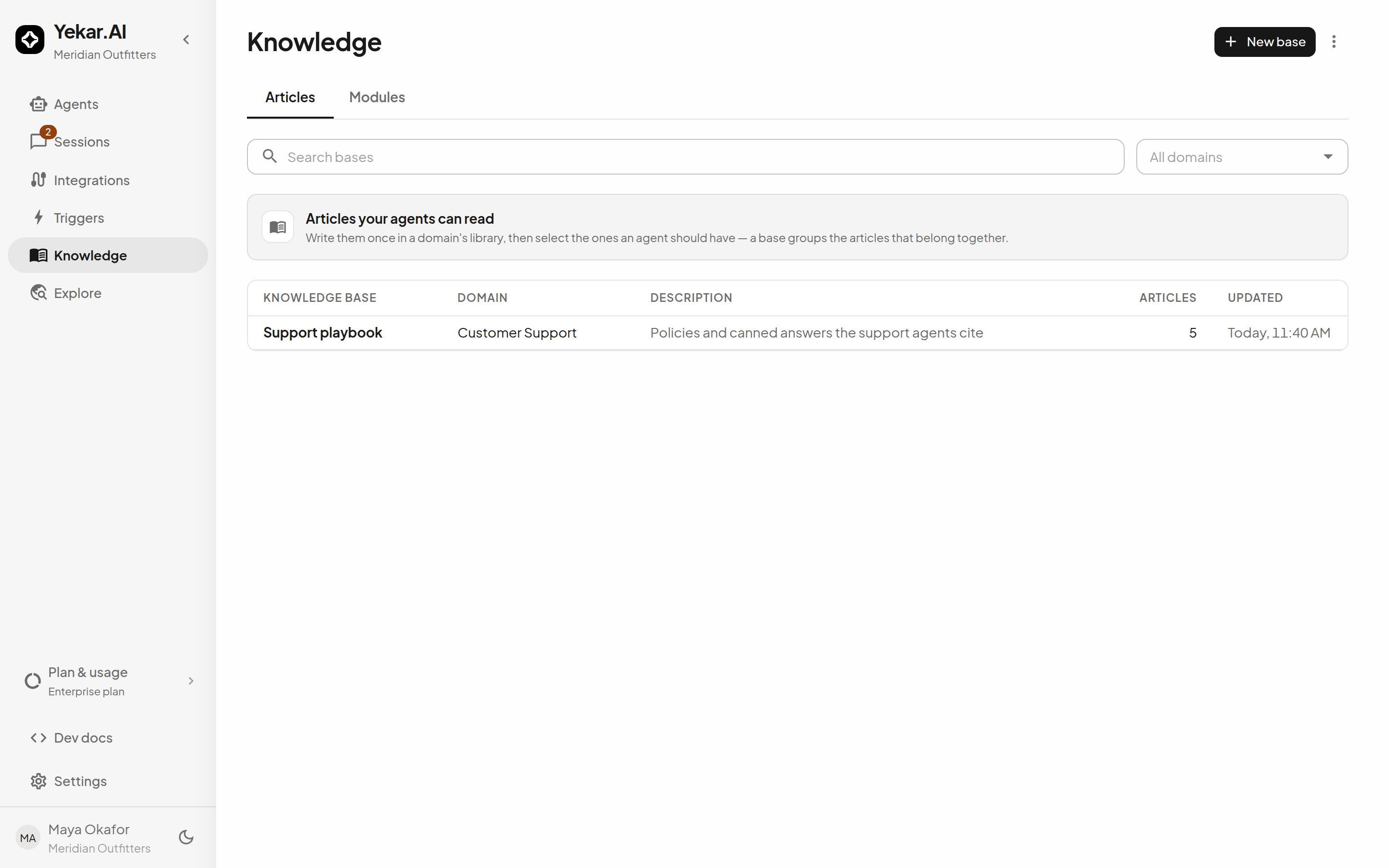
How it fits together
- A knowledge base belongs to the organization or a domain and holds articles.
- An article is one item - an uploaded or crawled DOCUMENT that flows to searchable on its own (Processing → Active, or Failed with retry), or a WRITTEN article that is drafted, published, and versioned by its author. See Documents and written articles.
- A module groups articles into a reusable selection an Agent or App binds as one unit.
- An Agent binds a selection - none, its domain's articles, everything org-visible, or specific modules - and retrieval takes it from there.
This is a different tier from an Agent's own uploaded files: files belong to one Agent, organization knowledge is curated centrally and shared. Both appear in the Agent's Knowledge drawer, side by side - see Using knowledge in Agents.
Visibility
Each article is visible to its domain only, or to the whole org - the chips on the articles list say which. An org-visible article can be read by agents outside its home domain; a domain-visible one cannot. Modules have the same split: domain modules and org-wide modules.
Articles in an organization knowledge base always have Organization visibility and have no owning domain. Domain-owned articles can be shared individually with the organization.
Create a knowledge base
Open Knowledge → New base and choose Belongs to:
- Whole organization creates a shared base with no domain. Organization Owners and Admins can create and manage it.
- Domain shows the domain selector. Choose a domain where you are an Editor or Owner; if only one is available, it is selected automatically.
Enter a name and optional description, then select Create base. Add written articles, upload files, or crawl pages as usual. Each article inherits the base's ownership. Agents can use published organization articles through their Organization knowledge selection or a selected module containing them, and reference them with / in Procedure. See Using knowledge in Agents.
If the plan allows only one domain, new knowledge bases belong to the whole organization and the drawer has no domain selector. Domain creation and domain imports are unavailable on that plan. This follows the plan's allowance, even if multiple domains remain from an earlier plan; existing domain bases remain readable and editable with their usual permissions.
Permissions
Organization members can read organization-owned knowledge. Organization Owners and Admins manage organization bases and their articles, organization-wide modules, and OCR spending approvals. All domain members can read their domain's knowledge; creating, editing and publishing domain bases, articles and modules, uploading documents and retrying ingestion require Editor or Owner access in that domain. Organization roles do not bypass domain knowledge-management permissions. See Roles and permissions.
Export and import
A domain's knowledge round-trips: export produces a portable snapshot of bases, articles, and modules, and import recreates them - useful for staging content or moving a playbook between workspaces.
Tips
If an Agent doesn't use an article you expect, work through the checklist in Using knowledge in Agents - published state, visibility, and the Agent's selection are the three usual causes.