Bind knowledge and let retrieval work
An Agent binds organization knowledge through its Knowledge drawer - open it from the Agent page's anatomy or rail. The drawer's Files tab holds the Agent's own uploaded files; the Knowledge tab is where it selects organization knowledge.
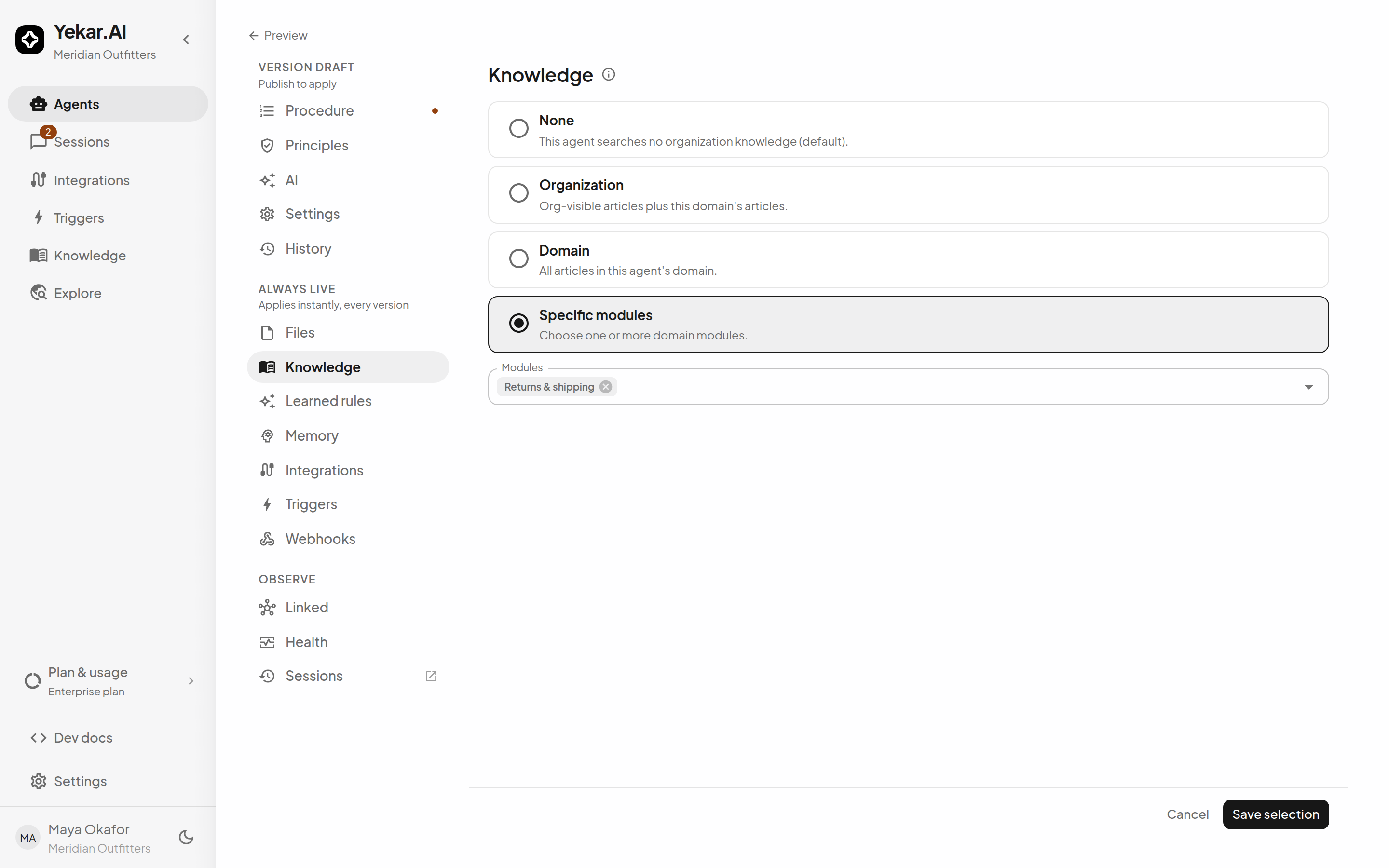
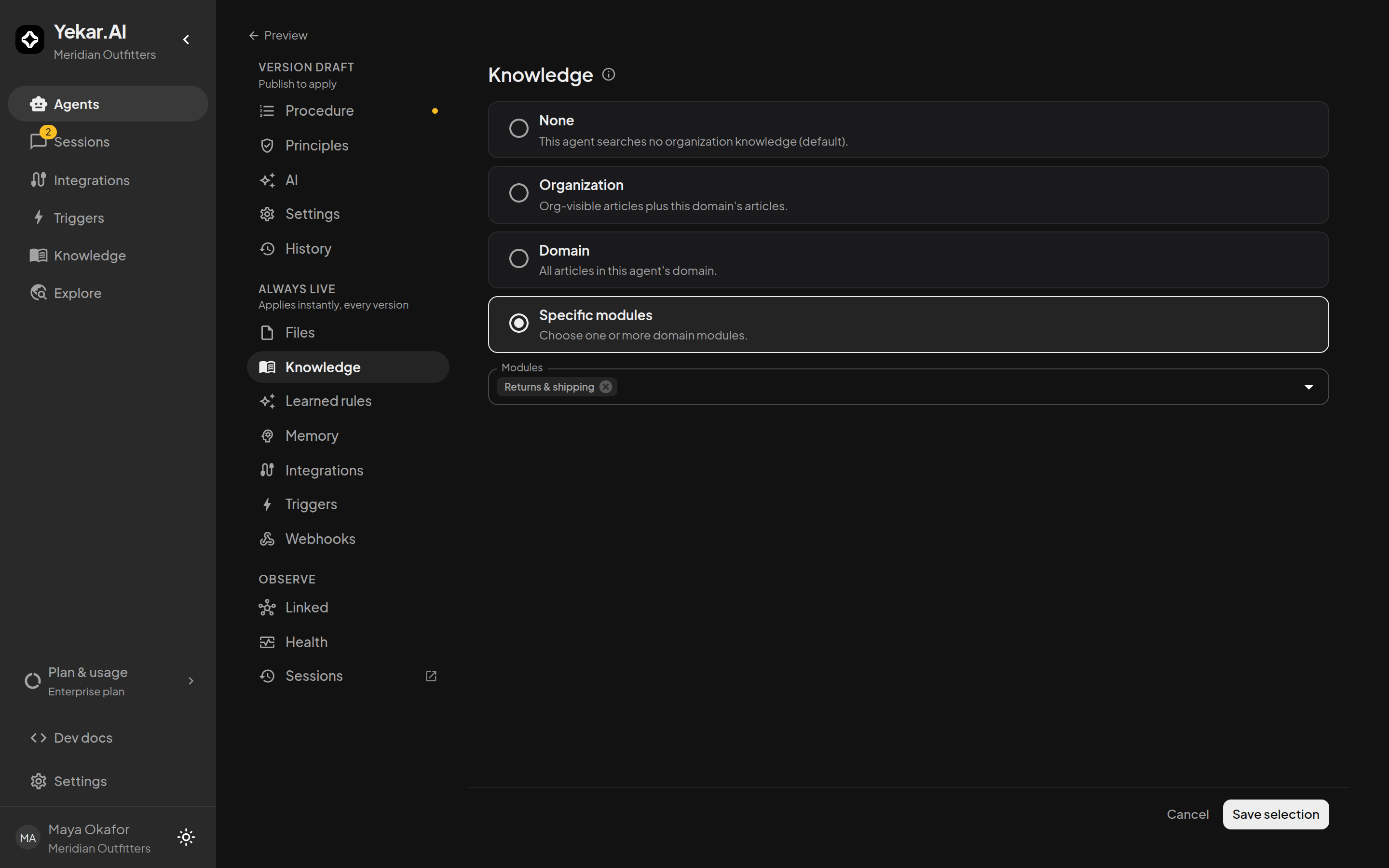
The four selections
- None (default) - the Agent searches no organization knowledge.
- Organization - articles in organization-owned bases, domain-owned articles shared with the organization, and its own domain's articles.
- Domain - all articles in the Agent's domain.
- Specific modules - one or more of its domain's modules, picked by name.
It is one selection for the Agent, applied on every run - sessions and triggers alike see the same knowledge. The selection works on live state: changing it takes effect on the next turn without publishing the Setup.
Only published article versions are ever retrieved - drafts and archived articles are invisible to agents regardless of the selection.
Reference an article in Procedure
Type / in Procedure, search by title, and select an article to insert a reference. The same picker includes ready files attached to the Agent. In Standard execution mode, referenced sources are loaded into each turn, using the article's current published content. All other articles in the saved selection remain available for retrieval, even without a reference.
The picker respects the Agent's selection and article visibility. Organization does not include another domain's domain-only articles; those must be shared with Organization visibility. Save selection changes, then reopen / to refresh the list. See Procedure references for examples and unavailable-source errors.
How retrieval reaches the model
What the Agent's selection produces is a corpus, and how it reaches the model depends on its size:
- Small corpus - the knowledge is injected into the turn verbatim. Nothing to retrieve; the model simply reads it.
- Large corpus - the content is split into sections, ranked against the turn's message, and the most relevant sections are injected. The session's context meter says so honestly - "retrieved k of N chunks" - rather than pretending everything fit.
- Very large corpus - the prompt carries only a small grounding set of the likeliest-relevant sections, and the Agent gains a knowledge-search tool it calls on its own initiative to reach the rest mid-turn.
How a passage is found
Ranking is semantic and keyword search together, fused into one ordering. A question phrased nothing like the document still reaches the right passage - "what happens if the parcel never turns up" finds a section headed Lost shipments with no word in common - while exact terms, product codes and error strings still match exactly, which pure semantic search is bad at.
Neither arm has to win. A passage that both arms rank highly rises above one that only one of them liked, so a query that is half plain English and half exact identifier is served by the same ranking.
When a hit lands mid-document, adjacent sections of the same parent are pulled in with it, so a definition split from the clause that uses it arrives whole rather than as a fragment that reads as if something is missing.
When nothing matches well enough
If the best passage is not a good enough match, the Agent says it cannot answer from what it has - it does not answer anyway from a weak match, and it does not quietly fall back to what the model happens to know.
This is deliberate, and it is the behaviour most worth having in a knowledge base people rely on: a confident wrong answer costs more than an honest "not covered". Those turns are counted on the Agent's Health page under Said it didn't know, so you can see how often it happens and add the documents that would close it.
You don't configure any of this - the thresholds are platform-defined, and the same selection behaves sensibly at every size.
Citations
A citation opens the original file at the cited page - the PDF your team already knows, not an extracted text blob, so a reviewer checking an answer reads the same page the Agent did. Citations are derived from what the turn actually retrieved rather than from what the reply says, so one cannot name a document the Agent never opened.
When a turn actually drew on knowledge, the conversation shows citations - which articles the answer leaned on, linked back to the article pages. The session details panel also discloses the knowledge share of the context window, so you can see what the Agent had in front of it.
Each article's Runs tab is the same trail from the other end: where this article's content was used, which is what you check before editing a policy that agents quote.
Tips
If an Agent doesn't use an article you expect, check three things in order:
- Is it live? An uploaded document must show Active - a Failed one offers Retry. A written article must have a published version. If it has Unpublished changes, the Agent reads the last published version until you publish the edits.
- Does its visibility cover the Agent? A
domainarticle is invisible outside its home domain. - Does the selection include it? None is the default; a module selection needs the article in the module, not merely in the base.
See Troubleshooting for execution-side failures.