Integrations
Your agents are only as useful as the systems they can reach. Yekar.AI ships with more than 120 integrations already built - mail, chat, payments, storefronts, spreadsheets, CRMs, ticketing, analytics - so the work you want automated is usually one connection away rather than one engineering project away.
Connect an account once; every Agent and Flow then calls that integration's tools as the identity you chose.
The catalog
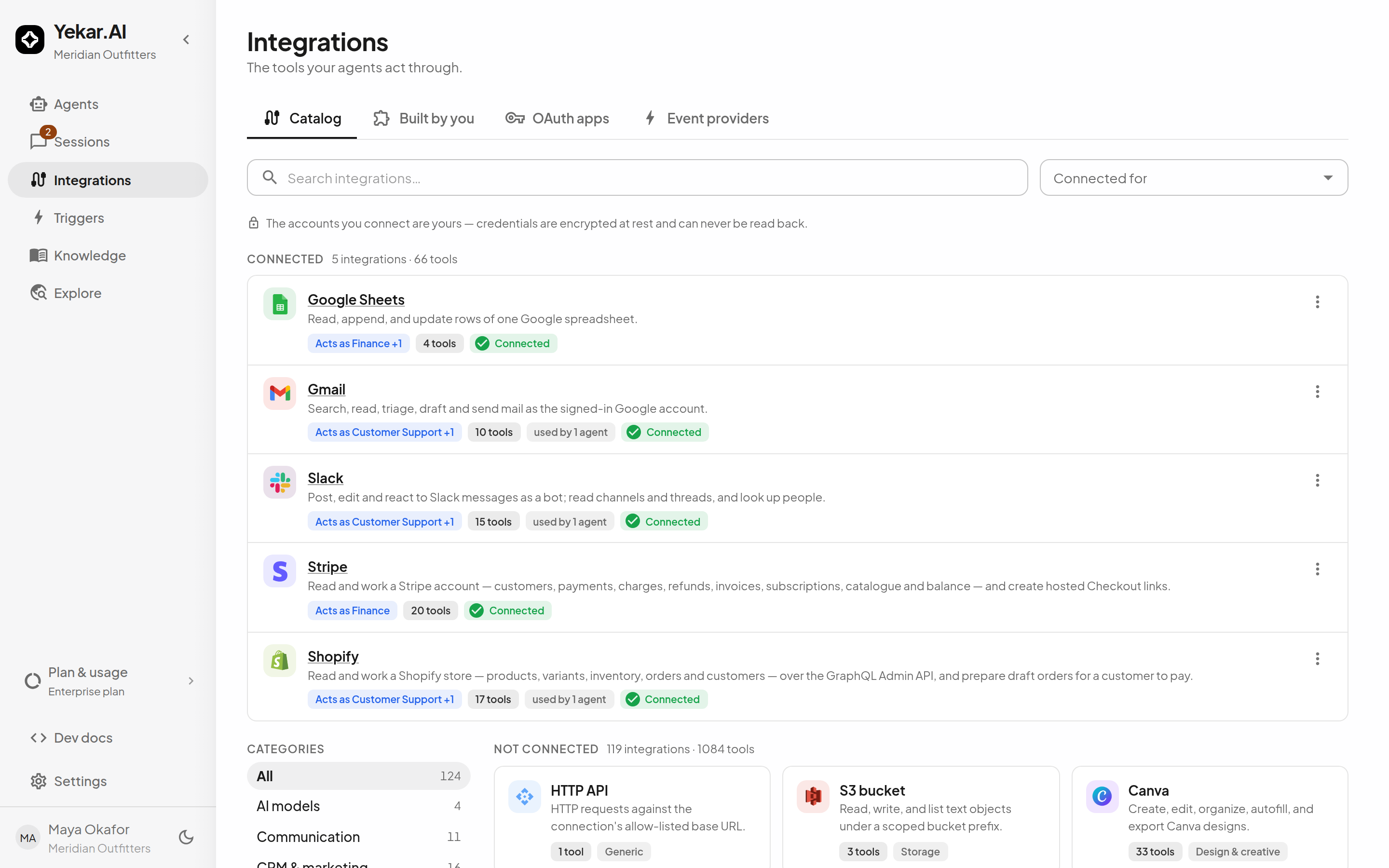
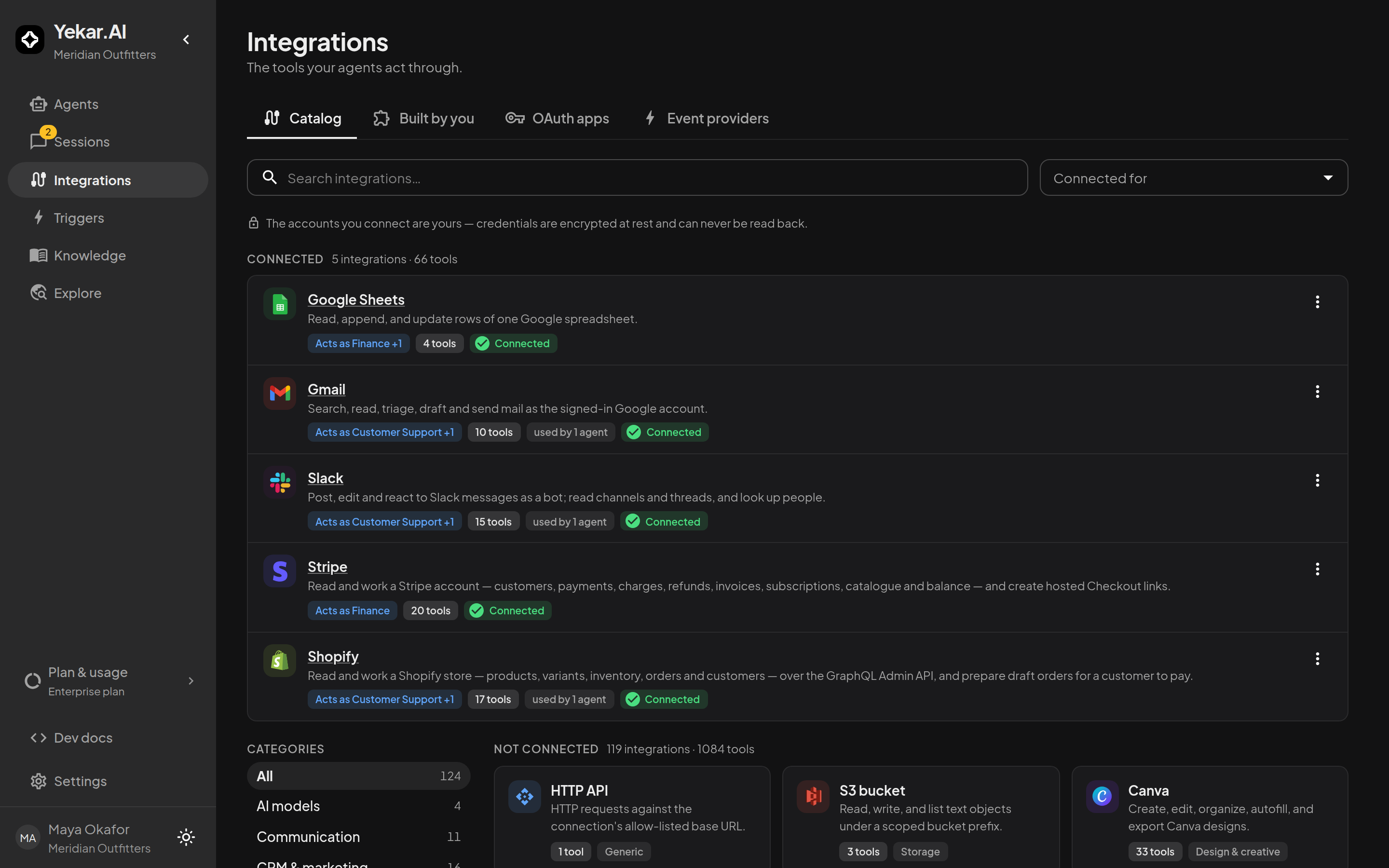
Open Integrations → Catalog. Each card names the integration, what it does, its tool count, and its category. Connected integrations - those with a usable account for you or your domains - sort first.
The catalog ships with 120+ integrations across communication (Gmail, Slack, Teams, Outlook, Resend…), e-commerce and payments (Shopify, Stripe, Square…), CRMs (HubSpot, Salesforce, Attio, Pipedrive…), documents and files (Google Drive, Sheets, Docs, Notion, Confluence, Coda, OneDrive, Dropbox…), project management (Jira, Linear, Asana, ClickUp…), research and web search (Exa, Tavily, Firecrawl, Google Maps…), developer and observability tools (GitHub, Datadog, PagerDuty, Vercel, ClickHouse…), meetings (Zoom, Fireflies.ai, Granola), scheduling, marketing, accounting, and social - plus generic HTTP and webhook integrations for everything else.
The Catalog section describes each integration's tools and usage. External integrations include account connection instructions. Built-in tools are managed by Yekar.AI and are available when enabled for your workspace.
Tools, reads, and writes
An integration exposes tools - Get order, Send message, Create refund - that Agents reference from their Procedure and Flows call as steps. Every tool declares whether it is read-only, and your organization can override that treatment per tool (the badge then shows the override beside the declared value). The effective classification matters: it decides whether calls may run in parallel within a turn, and what the audit trail records for each call. It no longer limits what an Agent's own approval list may gate - that covers reads and writes alike.
Require approval on any tool
An organization Owner or Admin can require human approval before any tool runs - reads included - for every Agent in the organization at once: open the integration's page, select Enabled tools, and switch to Tool approvals. A required tool's calls pause in Approvals, whichever Agent made the call. This organization requirement always takes precedence over an agent-selected confirmation. An Agent can add more gates but cannot remove an organization requirement, and Agent settings show the organization-required tools beside that list.
Where accounts live
Most connections are owned by a domain - a team account managed by that domain's owners, and the identity agents and flows in it run as. A domain can hold several named credentials per integration - Production, Staging - and choose which is default.
Beside them, a person can hold their own sign-in for an integration, once per organization, for agents set to run as the person using it. A personal sign-in is a credential and nothing else - the settings and enabled tools always come from the domain's connection - and it exists only where a domain owner has opened that door. Both live on the one Integrations screen, chosen with Acting as.
Connecting is covered in Connect an integration; which one an agent or flow uses is covered in Identity.
Beyond the catalog
Organization admins can author custom integrations against any HTTP API, and import tools from an MCP server, in Integrations → Built by you. See Custom integrations & MCP.
OAuth apps
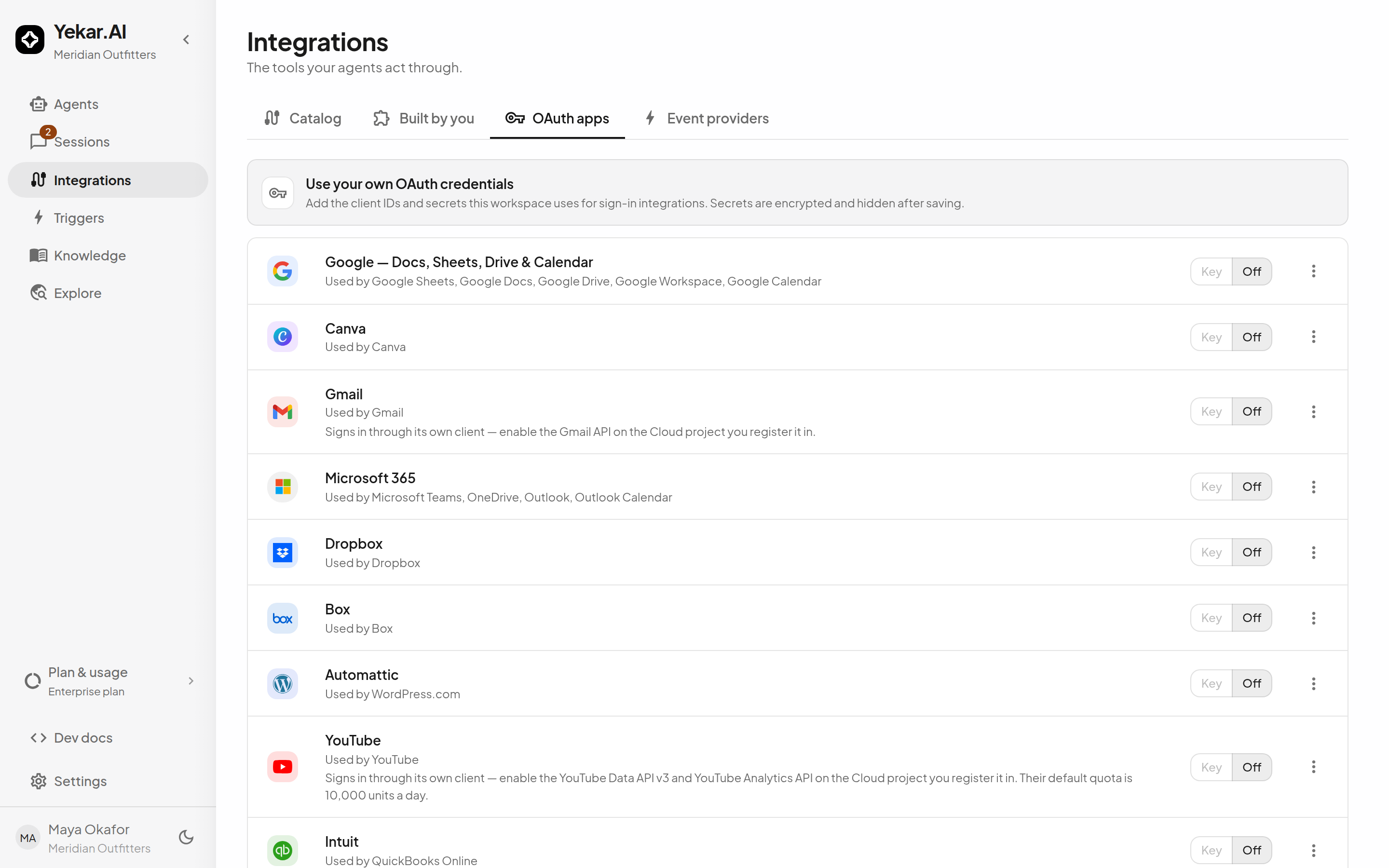
Some OAuth providers want your organization's own app registration - which is usually what you want anyway, since consent screens then carry your name rather than ours. An administrator configures those under Integrations → OAuth apps.
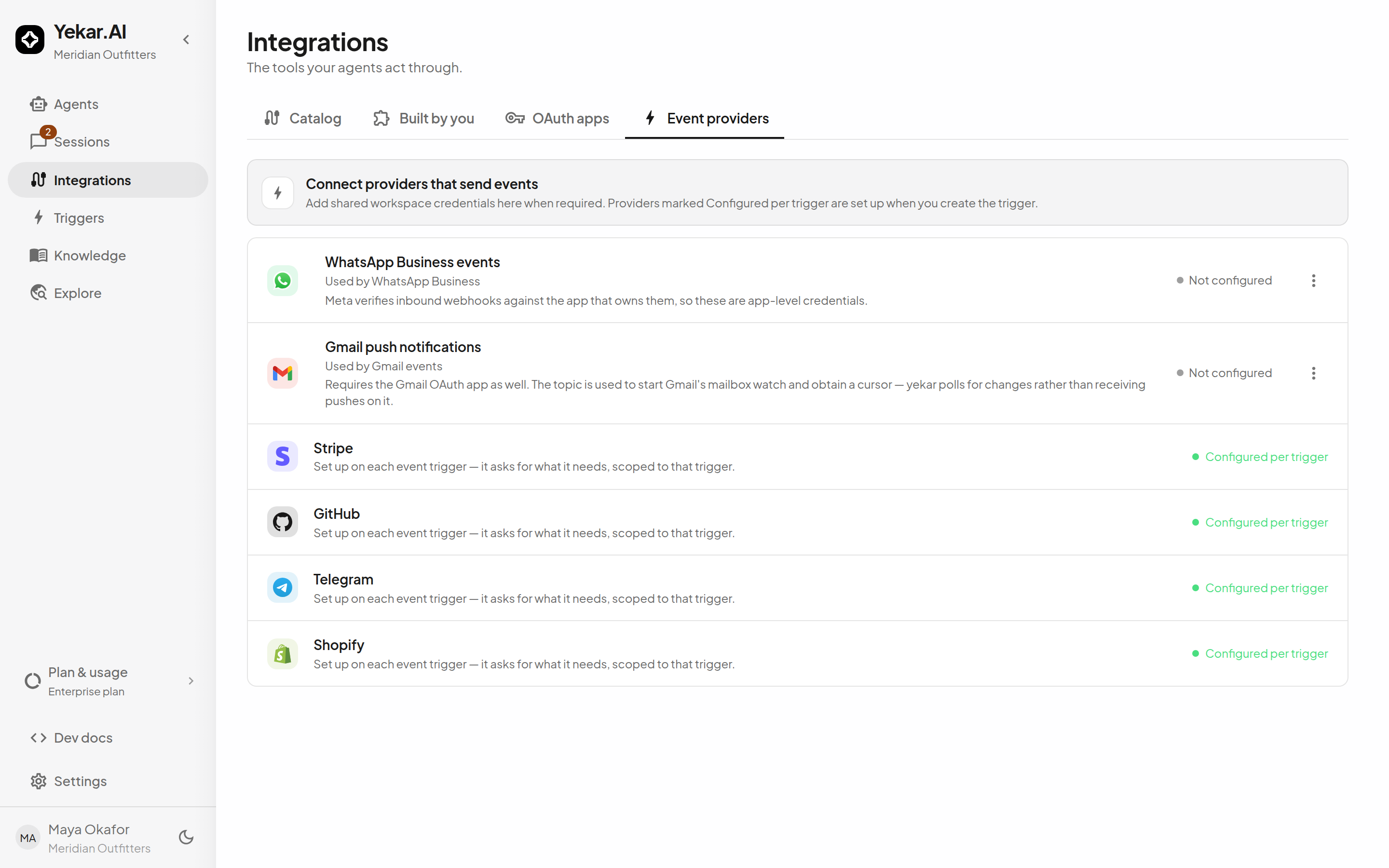
Event providers
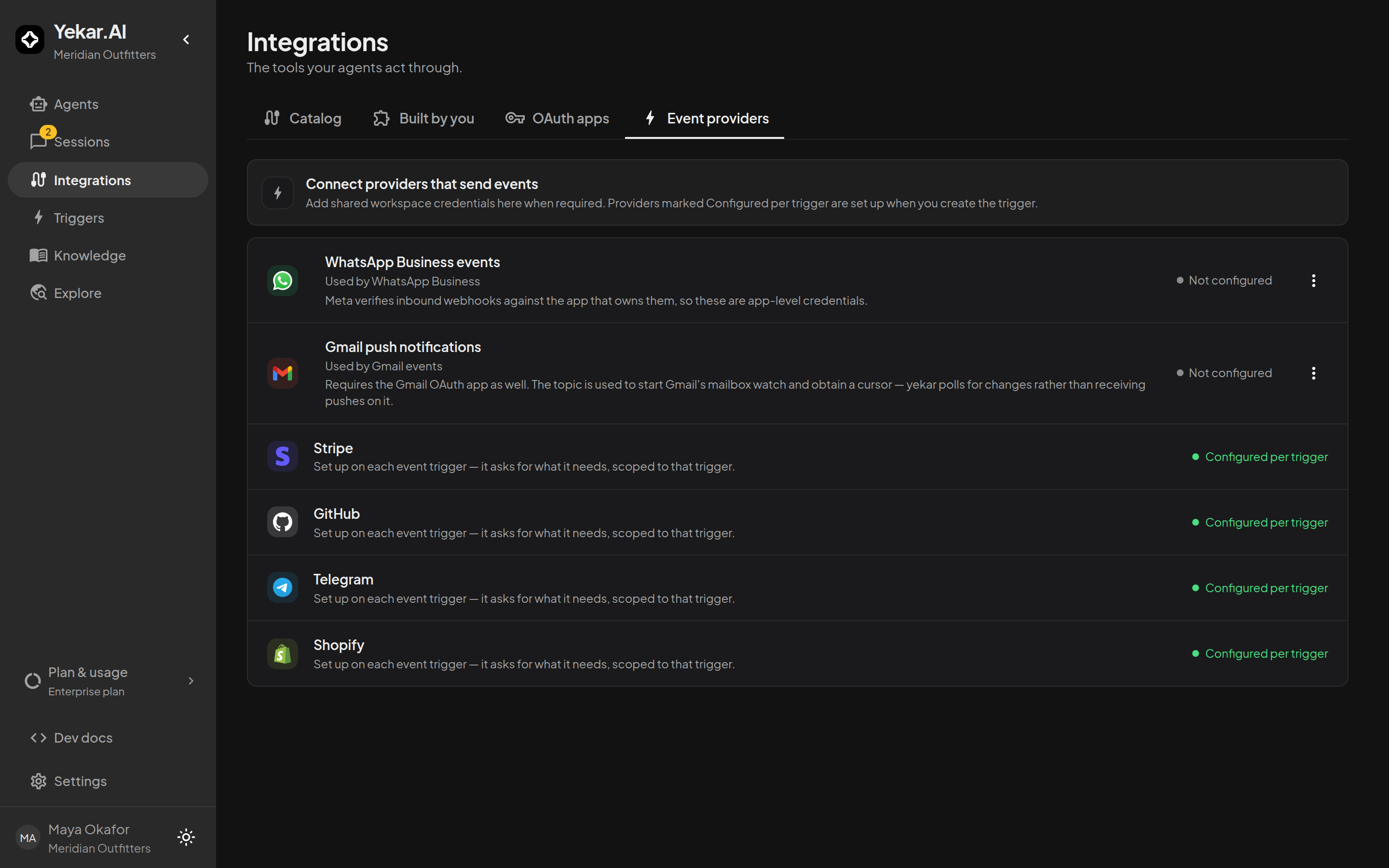
Several integrations can push events to Yekar.AI - a Stripe payment, a Shopify order, a GitHub push, a new Gmail or Outlook message, a Slack message, a Microsoft Teams channel post or chat message, an inbound Telegram or WhatsApp message. Triggers → Event providers is where those inbound channels are set up and their health is visible, so an agent can react the moment something happens instead of waiting for the next schedule.
See Triggers for turning an inbound event into work.