Step reference
Every Flow is built from these step types. Each step names what runs next; templated fields interpolate run inputs and earlier steps' outputs (see Inputs & data).
| Step | Picker group | What it does |
|---|---|---|
| Tool call | Connected apps & data | Calls one integration tool with templated parameters. |
| AI task | AI & agents | Runs a model prompt over selected earlier outputs, optionally against an output schema. |
| Branch | Logic & timing | Evaluates a condition and routes to the true or false outlet. |
| Approval | People | Parks the run until someone with the required domain role approves or rejects. |
| Human task | People | Parks the run until a person submits a declared form. |
| Transform | Logic & timing | Reshapes data with a field mapping - no external call. |
| Wait | Logic & timing | Parks the run for a fixed duration or until a timestamp. |
| Poll | Logic & timing | Repeats a tool call until its output settles a condition, on a bounded schedule. |
| Parallel | Logic & timing | Fans out into named branches and joins when all complete. |
| Run agent or flow | AI & agents | Fires another Yekar.AI agent or flow - a message to an Agent or input to a Flow. |
| Web search | AI & agents | Searches the open web and returns snippets. |
Tool call
Calls one tool on a connected integration. Parameters are templated, and the right connected account resolves from the flow's identity settings when you save.
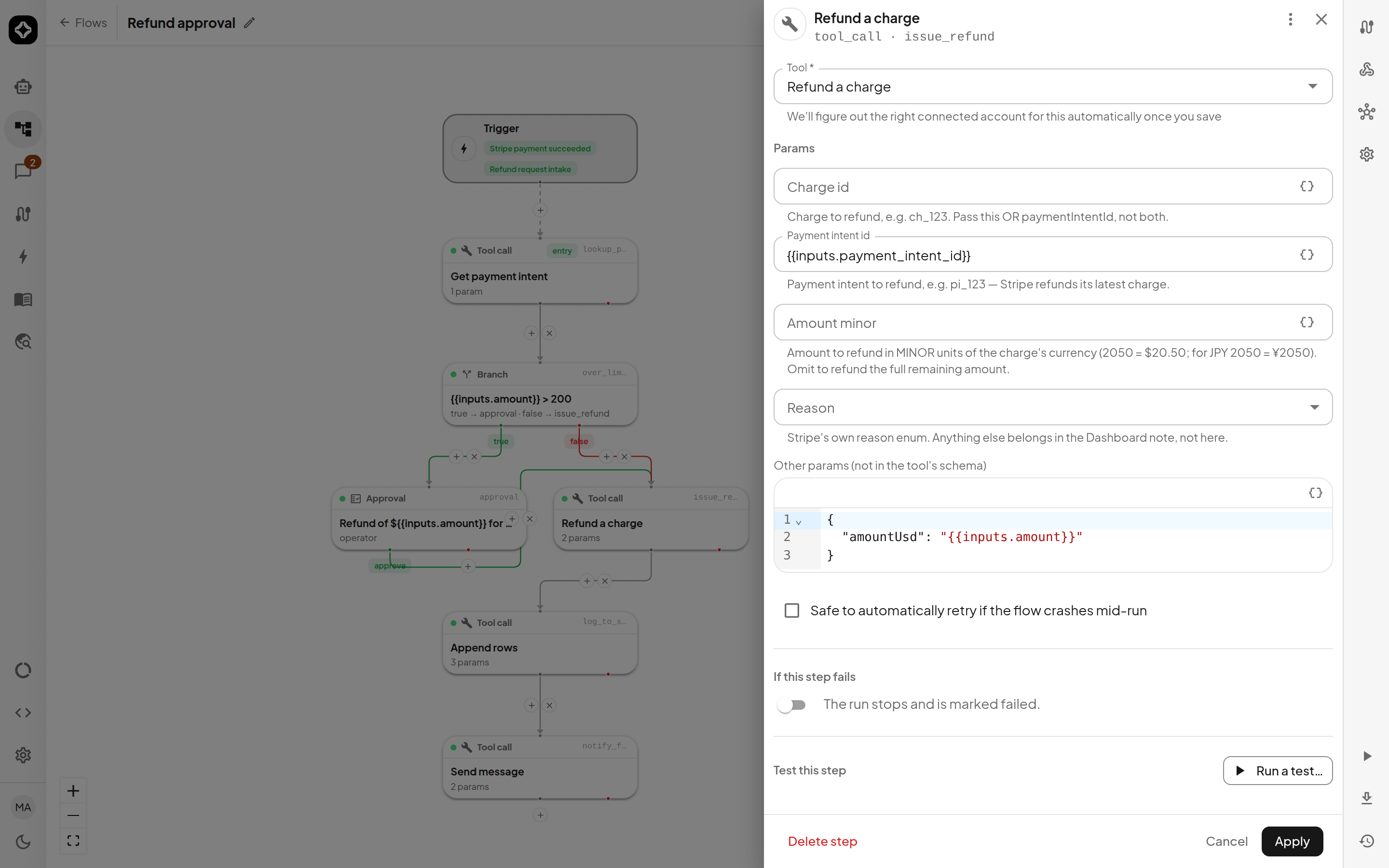
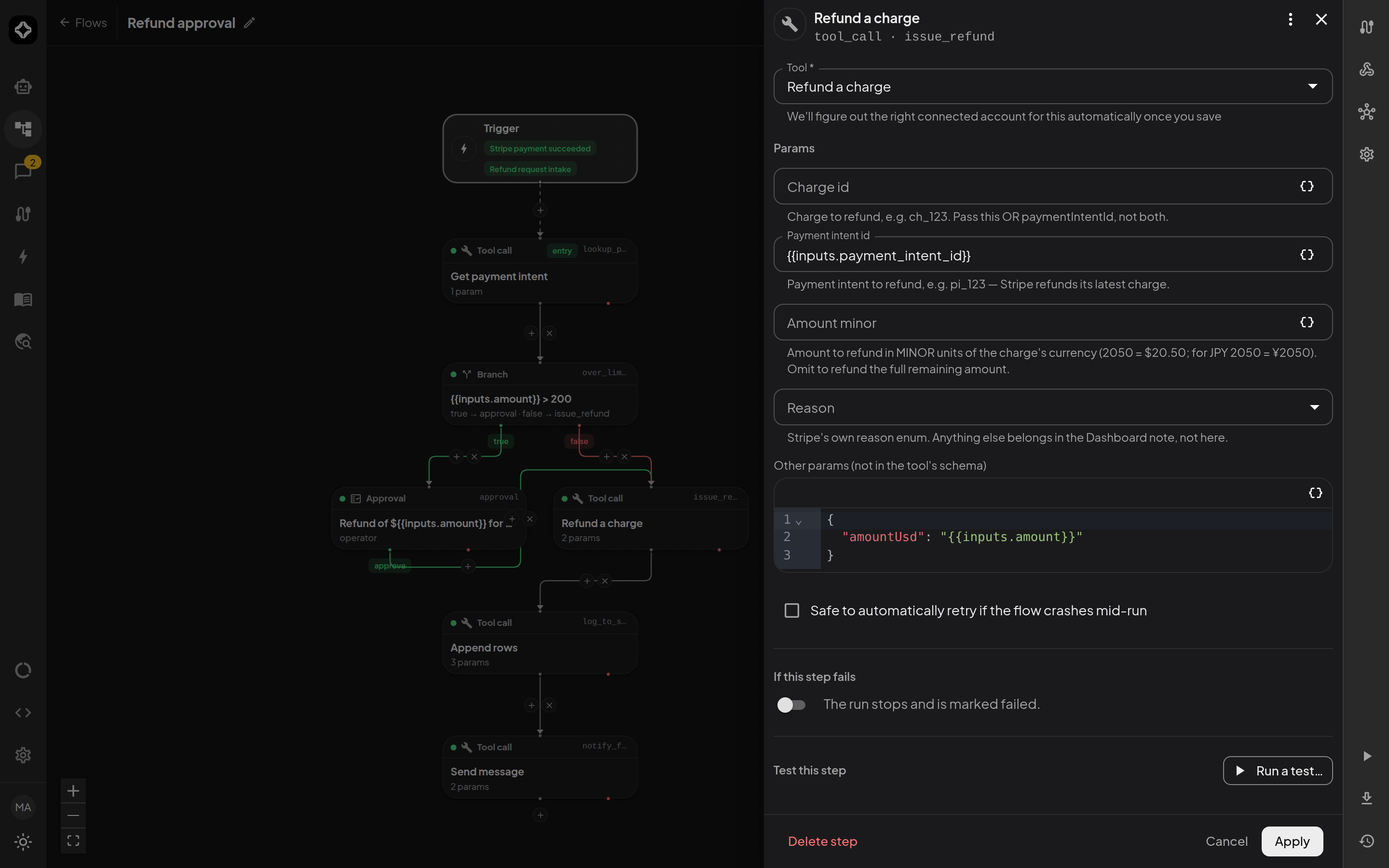
Options that matter in production:
- Failure routing - connect the red outlet to handle the failure; without it the run stops and is marked failed.
- Retry - configurable retry for transient failures.
- Idempotency - a step marked idempotent may be retried automatically after a crash; a templated idempotency key is recorded on every call and, on tools that support it, lets an interrupted write be re-run with the same key instead of failing conservatively.
AI task
Runs a prompt with selected earlier outputs as context. Choose a model from the catalog or leave it to the engine default. Provide an output schema when later steps need structured fields rather than natural-language text.
Branch
One condition, two outlets. Conditions compare templated references - {{inputs.amount}} > 200 - and route accordingly.
Approval
Parks the run and posts an item to Sessions → Approvals. You choose the message (templated), the minimum domain role (viewer, operator, editor, or owner - default operator), and where approval and rejection each route. For domain-routed work, the approver must satisfy both the domain's approval policy and this step's role floor. Disallow self-approval prevents the run's initiator from approving their own gate. A gate that expires or is rejected with no rejection route fails the run.
Human task
Like an approval, but collects data: you declare the form fields (typed, with required flags), and the submitted values become the step's output. Submission requires Operator or above and the step's assignee-role floor. Being named as an approver under the domain policy does not give a Viewer permission to complete human tasks. See Roles and permissions.
Transform
A pure mapping from earlier outputs to a new shape. Use it to keep tool parameters simple instead of repeating deep references.
Wait
Parks the run on the clock - a fixed ISO-8601 duration (days, hours, minutes, seconds; up to 30 days) or an interpolable timestamp. A waiting run does not count as running, so it does not use its flow’s concurrency.
Poll
"Call this until it settles": executes like a tool call, then tests an until condition against that attempt's output. Unsettled attempts park the run until the next interval. Bounds are enforced - interval between 5 seconds and 1 hour, at most 500 attempts - and you choose where exhaustion routes; unrouted exhaustion fails the run.
Parallel
Fans out into two or more named branches and joins when all complete. Branch order is deliberately unspecified - branches must be independent; the join is the only ordering guarantee. On branch failure chooses whether the first failure stops the run or the remaining branches finish and the join sees the error.
Run agent or flow
Calls another agent or flow in the same organization: a prompt for an Agent target, a typed input object for a Flow target. Cycle and depth guards apply.
Web search
Searches the open web and returns snippets, framed as untrusted input. Cap the result count in the step.