Agents
An Agent is a colleague you brief once. You write a Procedure - ordered instructions, in your own words - add Principles it must never break, and reference the tools it may use inline. From then on it works each request out for itself, calling those tools as needed, inside the guardrails you set.
Agents earn their keep on the work that eats your team's day and never quite justified an engineer: triaging a support inbox, answering where-is-my-order, chasing a delayed carrier, summarising a case before a human picks it up. Start from a curated agent in Explore and you can be live this afternoon; where Agent Builder is enabled you can describe the job instead and review the draft it writes. When a job has a fixed shape instead - the same steps, the same order, every time - reach for a Flow.
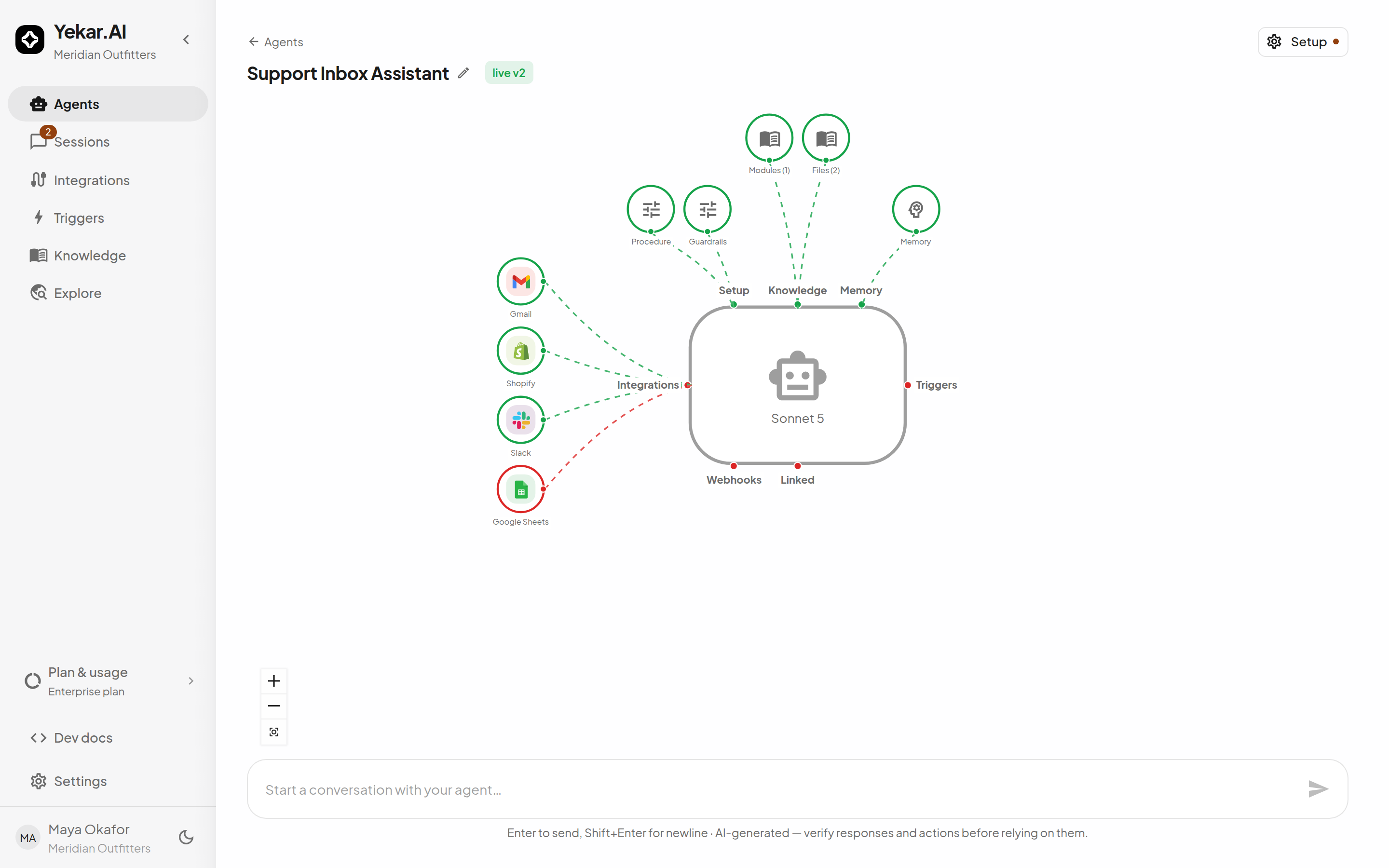
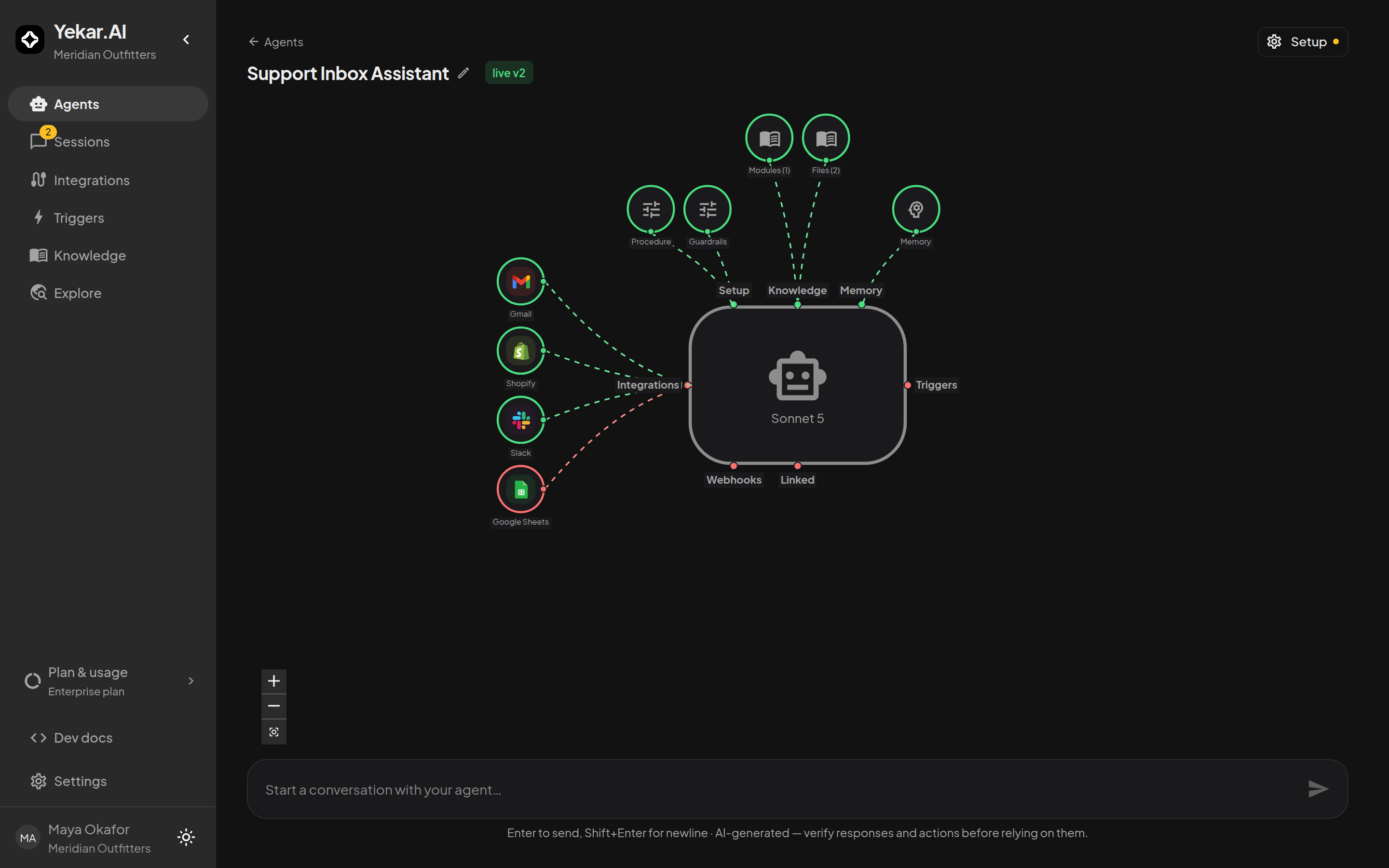
The page's centerpiece is the Agent's anatomy: a live map of everything wired into it - its model, the Setup's Procedure and Guardrails, knowledge files, memory, each bound integration, triggers, webhooks, and golden eval cases. Select any node or label to open the matching drawer; the same drawers are on the rail at the right edge. The agent cards on the Agents list show the same anatomy in miniature.
Anatomy of an Agent
The Agent page offers configuration and operational navigation appropriate to your permissions. Setup holds the draft - what you edit and publish; the other drawers work on live state and take effect without a publish:
| Control | What it holds |
|---|---|
| Setup | The draft, in five panels: Procedure, Principles, AI (model, response mode, limits), Settings (memory switch, approvals, output shape) and History. Publish and Test drive live in its footer. |
| Knowledge | Uploaded files the Agent can read, the organization knowledge it binds, and the rules it has learned. Applies to all versions - no publish needed. |
| Memory | The Agent's accumulated cases: search, open/closed states, cleanup. |
| Evals | Golden cases, scored assertions and suite runs - the Agent's regression harness. |
| Health | What the Agent did in production: where answers came from, what was repaired, and how each Setup revision compares. |
| Integrations | The integrations derived from Procedure tool references, and whose account each one runs as. |
| Triggers | Schedules, API triggers, and event triggers this Agent is subscribed to. |
| Webhooks | Outbound webhooks fired when this Agent's work completes or fails. |
| Linked | Calls between this Agent and the other agents and flows it fires or is fired by. |
| History | The Agent's sessions. |
For people with edit permission, the header chips distinguish the published revision from draft changes: live v2 is the published revision new sessions run; unpublished changes means the draft differs from what is live.
Access to configuration
Every domain member can inspect an agent's configuration and revision history. Editors and Owners can create, edit, publish, archive and use Builder. Viewers and Operators see the Markdown, JSON and form components with editing disabled, without draft-version labels or unpublished-change dots. The Integrations configuration entry is available to domain Owners; Operators and above can manage triggers and webhooks. See Roles and permissions.
The lifecycle
- Create the Agent in a domain - the domain decides which team accounts and members it works with.
- Write the Setup - the draft autosaves as you type and never goes live on its own.
- Test drive the draft in a real conversation with real tools.
- Publish - a numbered revision becomes what every new turn runs.
- Run and monitor sessions, decide approvals, and iterate: edit the draft, publish again.
Each part has its own page in this section:
- Procedure & Principles - writing instructions and referencing tools
- Knowledge, memory & web search
- Integrations & identity - whose account each tool call uses
- AI & Settings - model, limits, output shape, approval gating
- Test drive & publish - drafts, revisions, history
- Evals - cases, replays and the publish gate (available on request)
Where Agents run
Every published Agent can be run from its own composer, from Sessions → New session, on a trigger, over the API, or from another agent or flow. Each conversation is a session; see Sessions for following the work.